
| Check out the news and view gaol videos almost as it happens – |
Half way stage and the big guns Brazil, Italy Argentina and Spain are leading their groups. |
 |
Author Archives: Kevin Bryant
Light at Last
Kent St will return to 4 matches a night – Monday 30th September. 
I am assured remedial work has been finished so floodlite futsal can resume; further major repairs are planned.
Thank you for your patience.
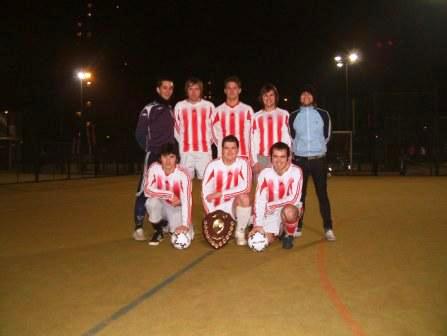
El Dogoes 2008 Tuesday League Champions, in the days the lights worked!
PRESS RELEASE: The FA Umbro National FUTSAL Finals – 27th-28th September 2008
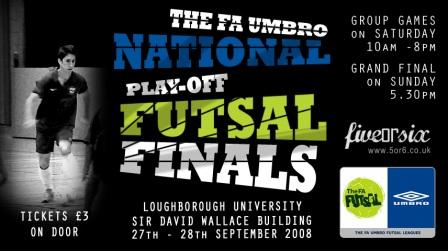
The FA Umbro National FUTSAL Finals is a showcase playoffs with six teams in
England battling it out for a place in the Futsal Uefa Cup.
The FA are in partnership with Loughborough University, Logistique and 5or6
design consultancy (www.5or6.co.uk) to host
the event.
Tickets on the door cost £3 for adults , U16s go free
Group games on Saturday 10am -8pm
Final will be at 5.30pm on Sunday
Small is Best Why the 4v format is the answer for youth foot
coach Dave Murphy visited Manchester United to see their Academy’s 4v4 project,
he witnessed a format and philosophy that he knew would take youth development
at grass roots to a higher level.
In this article we look at both the
Manchester United 4v4 project and the influence it is having lower down the
ladder.
By Paul Cooper
A Brave New World
4v4 is not a new concept; the Dutch have
been playing it since the mid 1980s. The godfather of football in
Rinus Michels said,
“Good
coaches use the basic criteria of street football for their vision of grass
roots development; they realise that these elements produce a natural process
which gives the most efficient training for young kids.”
And there we have it, logical thinking from
a coach who understands that because of modern society, street football is no
more and that ‘the children’s game’ MUST be continued in some form if we are
really serious about development. Some twenty years later in the
wrestling with the dilemma, “Is it the proper game?”
The 4v4 pilot scheme for the U9s at
Manchester United’s Academy was studied in depth by Rick Fenoglio from the
Department of Exercise and Sport Science,
Rick published his results of his research
in both the FA’s Insight magazine and in a major report he complied.
In the report Rick highlights the
underlying philosophy of the pilot study.
‘The
scheme was to re-create, as much as possible, a match day environment that was
more child and player-centered. This guiding concept led the developers of the
scheme to reflect upon football environments where the young player was free to
learn, practice and develop their football skills without being shackled by the
imposed structures, expectations, attentions and scrutiny of significant
others. The environments, which were considered to provide these qualities the
most, were the playgrounds, parks, streets, back alleyways, beaches and barrios
around the world – areas where the world’s greatest players first learned their
skills. At this time,
United FC were re-considering their approach to the development of young
players and were concerned that the overall gap in skill levels between English
players and European players (and, increasingly, the rest of the world) was
widening.
If
true, this is an interesting situation given that one of the primary aims of
the initiation of Football Academies in
enhancement of technical skills. The 4 v 4 games and format of the pilot scheme
were selected because it was felt that they would give players more
opportunities to practice and develop their game-related skills in a less
pressurized, but nonetheless challenging game format. The environment of the
pilot scheme was developed from a desire to produce a more child-centered and
ethical learning environment.’
(A
4v4 Pilot Scheme for U9 Academy Football Players – Rick Fenoglio)
There is something
deeper here, and not just in a football sense. Remember childhood today is very
different from when I was growing up in the 1960s, kids are hardly allowed out
to play now. They don’t climb trees, ride bikes and build dens like they used
to.
Sue Palmer, child expert and writer puts it
a little more succinctly;
“Play-unstructured,
free range, loosely supervised play – is the birthright of every child. For the
next generation to grow up healthy, balanced and able to benefit from their
education, we must ensure that children once again go out to play.”
If we are always going to tell children
what to do and treat them like mini adult professionals at eight and nine, when
are they ever going to think for themselves?
In terms of technique and problem solving
skills, I feel there is a definite link between the
last summers World Cup and what is happening on the fields of
youngest age levels in both the grass roots and professional game.
Fear is everywhere in football in this
country, fear of losing, fear of change, fear that the next coach knows more
than you and the fear of giving control on the pitch to the kids.
The games
United picked four different 4v4 games (8
minutes each) and the players rotate so that they play all the games. On
average each child played about six games.
Game 1 – Goalkeeeper Game
4v4 + keepers
Pitch size: 35 x 25m
Goals: Junior size goals 18×6 feet
Game 2 – Two Goal Game
4v4
Pitch size: 30x25m
Goals: 2 large traffic cones at each end
No keepers, dribble or pass the ball on
Game 3 – Four Goal Game
4v4
Pitch size: 25×25
Goals: 2 goals at each end (4 goals in
total) by the corners, using traffic cones
Dribble or pass the ball on
Game 4 – Line Ball
4v4
Pitch Size: 25×20
Goals: The length of the line at each end
(to score go over the line and put your foot on the ball)
Dribble or pass the ball on.
Each game is 8 minutes long and very
importantly the children referee their own games. This allows them to take
responsibility, communicate with the opposition and sort out any problems. This
helps with their social development skills.
The coaches also take a back seat and just
encourage. This allows children to express themselves more to problem solve and
think for themselves.
The study looked at game data as well as
interviews with players, coaches and parents.
The results were nothing short of
staggering.
Compared to the 8v8 game the data was as
follows for the 4v4 games:
Number of passes – increase of 135%
Scoring attempts – increase of 260%
Number of goals scored – increase of 500%
Number of 1v1 encounters – increase of 225%
Number of dribbling skills (tricks) –
increase of 280%
From the interviews conducted, 80% were
positive regarding the 4v4 pilot scheme and 20% were negative.
The consensus was that the children became
a lot more skillful playing the 4v4 games. The games were varied which also
brought out different skills. It was also not so obvious who was a defender and
who was an attacker as the children became more complete footballers.
The Future
Despite the overwhelming statistical
evidence and the positive feedback, the Academy clubs decided to stick with the
traditional 8v8 format. Manchester United continue to play 4v4 at under 9s.
I personally feel this is an opportunity
missed, but I do understand that the 8v8 game is a good format on the road to
playing 11v11, but at what age do you bring it in?
Our football culture is one of passion and
commitment, two very important factors in both successful players and teams, and
if those attributes were the only important ones, as a nation we would probably
win a few trophies, however skill and decision-making are also involved and if
you take away the chance to develop that further at eight and nine years old,
you are always going to be playing catch up.
Dave Murphy
You meet many coaches in youth football,
some make no impact, but every now and then you meet someone who re-kindles
your enthusiasm in the struggle to put development first in youth football.
Just over the bridge in
Wales
about down the local park and before long he had 20 kids playing, such is his infectious
enthusiasm to involve everyone.
The Dutch 4v4 format is a central part of
Dave’s coaching philosophy at
to see the 4v4 scheme in action at Manchester United; I met Dave on a coaching
course.
Although a convert myself to 4v4s I had
only ever used the games in training sessions and had not thought of playing a
number of different games as a ‘match day’ substitute.
It makes so much sense. The mini soccer
leagues play 7v7 and very often at clubs it is impossible to play all the kids.
A number of different 4v4 games are the answer. The benefits at grass roots
level are obvious.
- It is a very flexible format, pitches can be marked out with
cones and you can have as many different 4v4 games as you have kids. - Everyone plays
- Many touches of the ball
- The different games bring out different skills
- Many opportunities for everyone to score goals
- Lots of problem solving opportunities without coaches talking
you through the game - Kids are not just a defender or an attacker but a footballer
and have a much better all round understanding of the game - You don’t even need to play another club, you can make it
in-house if you have enough kids
Actually the
list is endless.
town
Dave and twenty
of
and parents traveled to
afternoon in September for a 4v4 fun day.
The U9s and U10s
were mixed up and four pitches were laid out, the same as at Manchester United,
(all except the goalkeeper game which was changed to a most interesting game
Dave got from some Real Madrid coaches, which involves two goals back to back
in the middle of the pitch. More of that in the next issue)
I knew it would
be a good afternoon but I had not anticipated just how many touches each child
had and when left to their own devices how quickly they adapted to the games
and how advanced the children’s problem solving skills were.
Street football
As I mentioned
earlier, the Dutch addressed the decline in street football, ‘the children’s
game’ over twenty years ago but I feel we have never properly done that in the
In a world where
children can no longer play outside without supervision, parents and coaches have taken over. And the
competitive drive adults bring to the game means youngsters no longer have time
to fall in love with football, to play for fun and thus truly to develop their
skills.
Maybe, if the
4v4 message can spread, we can rear a generation of footballers who play with
creativity and without fear, who solve their own problems on the pitch, and who
enjoy the game. Footballers who play to win, instead of losing
through fear.
If you have any
comment to make about this article or you are interested in the 4v4 format
please email Paul Cooper on gill_cooper@tiscali.co.uk
Streamer: “I must admit that football in the streets gave us a great sense of
freedom and liberty.” Eric Cantona
Training to Mimic the Game: In Praise of 4 v 4
|


With thanks also to Ken Kontor editor of PERFORMANCE SOCCER
CONDITIONING who had the foresight to publish this article. http://www.performancecondition.com/soccer
Thus Ronaldinhos football career began

RONALDINHO
its old passion did not forget, and this for good reason: "I learned many
elements of my current technology with the Futsal. On small playing fields the
ball treatment is many more important, since one has less place. If you are not
fast and lead closely the ball, you lose him immediately."
FIFA is also promoting futsal as the official form of small sided football, due
to the fact that futsal develops the technique of each player. In
is a career choice with many players playing in European leagues. Some players
will choose to carry on playing futsal, whereas others will move in to
football. One of these players was Ronaldinho: "FUTSAL is faster and
closer than normal football. Speed,perfect technology and rapid apprehension
are the central things you learn with the futsal."
These are many of the reasons why FIFA promotes futsal. This special game is
not a competitor of football, but rather an enriching and extremely attractive
alternative for all lovers of the soccer game. Ronaldinho recommends futsal to
all children who are inspired by football: "as a boy it is better to play
on small fields because one comes into contact with the ball more
frequently..somewhat completely crucial. Only if you practice and often the
ball have, you become better.Futsal helps therefore the small ones to develop
their technology and understand its play"
Why Futsal?
WHY FUTSAL?
·
Fair Play
incorporated into games rules structure
·
Fast open game
played at pace
·
Develops fast
quick thinking , skilful players
·
Played to
touchlines not walls, making players use drag backs etc to utilise space
·
4v4 outfield is
the optimum number of players to enhance skill and technique whilst recreating
the realities of 11v 11 football ( Manchester Metropolitan University 2004
study)
·
Players have many
more touches of the ball compared to 6 v 6
upwards and upwards
· Players are
constantly involved in the game
·
World’s most
played small sided game
·
More teams enter
the Futsal World Cup than the 11v11 World Cup
·
Increases physical
and aerobic fitness
·
FA data confirms
that to play at the top in futsal 11v11 fitness is not sufficient
·
Futsal is the basis
for 11v11. Research has shown football
to be a series of interconnected 4×4 games, futsal is 4×4 at its most demanding
·
Futsal players
naturally find moving to football easy (Rolando)
·
Games improves spatial
awareness
·
Game is safer,
less injuries than ‘off the wall’ 5 aside or football
·
No advantage
because of a players physical dominance
·
Players from
‘futsal’ countries dominate our FA Premiership League
·
have won more World Cups than all the other countries added together, futsal
dominates booth countries. Futsal is
part of the schools curriculum in
·
The huge increase
in the games popularity witnessed by FIFA is testimony to the fact that players
enjoy the game. If they did not the game
would be imploding, when the opposite is the case. Watch a game, play the game, and then try and
say you do not love the game.
Kevin Bryant
Give us back our game
"The
‘giveusbackourgame’ campaign takes all the positive elements of street football
that gave generations of children so much fun amd produced so many great ball
players."
Paul Cooper – dutchUK football school
"Returning the game to the children is a terrific idea – particularly the
notion of children refereeing themselves. It teaches them about the spirit of
the game and the importance of communication.
I remember our mass playground games, with a tennis ball, (now outlawed by health
& safety of course) being governed in such a way. On one occassion, I was
found guilty of poaching another player’s goal and rather than the goal
being allowed, the boy who had the original shot was given a penalty. It was a
non-sensical reaction, but it showed that we realised stealing someone else’s
goal wasn’t an appropriate way to behave and I didn’t do it again."
Rob Linsdell – Give Us Back Our Game supporter
Street football was
very much the children’s game and important elements from it have inspired the
‘giveusbackourgame’ campaign,
Touches
Whether you were on your own kicking a ball against a wall or playing a game
with some of your mates in the park, the numerous football experiences allowed
children to have many touches of the ball. There was no running around the park
three times beforehand, you just got the ball out and played.
These many touches gave street players a great first touch.
Insight
There was no coaching, children had to problem solve the various situations
they encountered and learnt by playing. Often you would play against older boys
so you could not rely on physical strength alone. You had to compete by
superior technique and using your brain to out think opponents (insight)
Everybody played
Unlike youth football today, where adults decide who plays and who will not, in
street football everbody played. If you were one of the younger ones or were
not very good, you might be the last picked, but at least you got a game and
had the opportunity to improve. In modern youth football often the same kids
are either on the bench or left out every week, making it impossible to catch
up.
Fair games
If one team was dominating a game the children would swop players to make it
more even and start again at 0-0. They did this because more even teams made
for a more exciting and fun game. In modern youth football scores of 20-0 are
not that uncommon. That is no good to anyone.
Creative, attacking play
Different groups of children would make up different rules to reward creative,
attacking play. Two that my group of friends made were, double score for a
volley and after a team had won three corners in a row they were awarded a
penalty.
SOUNDS FROM THE STREETS (Probably will only make sense to sad, bald men of 50+)
(A nostalgic look back at street football)
BALLS
The Leather Football
The old leather football had a bladder inside an outer leather casing. Part of
the ball was laced to gain acess to the bladder.
When brand spanking new the ball was fine, if a little heavy. However no
material known to man changes as much under the influence of water, than the
old leather football. When carelessley left out in the garden at night, in the
rain. it turned into a killing machine.
The same effect could also be produced by leaving it out in a heavy frost. The
heaviness of the ball went from FA regulation weight to twice the weight of a
baby elephant.
The other hazard was the lacing, which if headed in a particular place
could open the forehead up deeper than a Hussar’s sabre.
The Light Plastic Ball
Cheap ball that came in a cheap plastic net. Usually red, yellow or blue with
black hexagons.
The ball was so light that even the slighest breeze could waft it to Venezuela and
beyond.
Frowned on by all street footballers and usually only purchased by well meaning
grandparents existing on a small state pension.
The Wembley Trophy Ball
The Holy Grail of street football.
The ball was quiet expensive, so was only given as Christmas or birthday
presents. Orange
with black lines it came in a presentation box with panels cut out to show off
the sexy curves of the ball.
Street football was great in the couple of months post Christmas as there was
an abundance of Wembley Trophies, but by the following December most had been
punctured, lost or stolen.
Having one of these punctured was like seeing your favourite family pet being
put to sleep at the vets.
Beware the cheap imitation ball sold at Woolworths under their own brand
Winfield label.
Any street footballer who had a Wembley Trophy down on his Christmas list but
received one of the Winfields instead would cry until Easter.
He would rather play with his sisters Sindy dolls than that fake pretender.
The Tennis Ball
Much loved by all street footballers and the main ball of choice for playground
football.
The ball can be stowed away in a trouser pocket and are cheap and plentiful. It
does not burst but like a middle age man eventually loses all its hair and
metamorpohse into a rubber ball which eventually splits along the seam.
This was the ball used by the great stars of the past, Matthews, Finney and
Charlton and was often kicked against a wall when playing solo.
The Airflow Ball
Hated and despised by street footballers. Indeed the playground footballers
would rather use a stone than this useless piece of plastic.
The airflow ball got its name as it is dotted with holes, held together with
rigid, shiny plastic. A run up of 100 yards and a full blooded kick will propel
the ball forward a mere six inches.
Sold in pet shops with the addition of a bell for the amusement of bored cats.
The Rubber Ball
The same size as a tennis ball but not as good.
Normally orange and occasionally blue. Sold in pet shops for the amusement of
large dogs that salivate a lot.
The Stone
Used in the playground as a last resort and occasionally headed by the class
lunatic looking for everlasting mythical status.
FOOTWEAR
The Football Boot
Rarely worn by street footballers unless you had a proper game down the park
with a team or gang.
The coup de grace was the George Best, maroon, side lace up boots. Cooler than
a Chopper and nearly as expensive. Out of the reach of most kids who had to
settle for ‘school football boots’ own brand from Freeman Hardy & Willis.
About as cool as wearing your grandad’s orthopaedic shoe and about as effective.
The Dap
The cheap man’s plimsole was black, elasticated and excellent for street
football. Gave you excellent close contact with the ball and felt like playing
in slippers, but gave very little protection from heavy challenges.
The dap was the ballet shoe of street football.
Black School Shoes
Worn in the playground as changing into your daps would mean less footie time
but a huge barney with your mum.
The standard lace up variety were only worn by boring kids with glasses who
looked like bank managers, even at the tender age of ten.
Then there was the slip on, which was quite trendy but one of the most
dangerous weapons known to man, ranking somewhere between the Scud missile and
the Atom bomb. Many a keeper has been dragged from his goal, bleeding, to the
school nurse after being hit by an Exorcet Clark’s slip on.
The scenario has been played out on many a playground. A player through on goal
strikes the ball with ferocious venom. He miss times the shot and his slip on
travels faster than the speed of sound, striking the hapless goalie on the
forehead, knocking him backwards and unconcious into his goal while the mis hit
shot trickles innocuously over the line.
Some players got their mums to buy a size too large pair of slip ons so they
could fire them off their feet at will. This gave them a certain street cred in
the playground as to how many keepers they had permanently disfigured.
The Desert Boot
Excellent for chasing Field Marshall Erwin Rommel around North Africa, but if
worn now would be repsonsible for many metartasal injuries (Break it like
Beckham) as the boots crumple on impact. I had a pair of desert boots and was
made to wear them on formal occassions as an alternative to school shoes. As my
brother and father also wore them, on family outings we looked like the cast of
Daktari. We only needed to camouflage the family mini and own a cross eyed lion
to make the deception complete.
VENUES
The Street
The street could be a lane, dual carriage way, path, road, street or ally.
It depended on where you live and how much dosh your dad had. The more dosh the
less football as the posh streets generally frowned on street football and
thought that boys should help old people with their garden, play chess and
build a 1930s detached surburban house from Mecanno.
The other thing posh people hoped their kids would do is invent some new wonder
drug with their 17/6 chemistry sets at the kitchen table.
Sadly like street football, the chemistry set has all but disappeared as
today’s mixed up teenagers from higher income bracket families, far from trying
to save the world with a new cure, are more likely to make some
hallucinogenic drugs or produce home made bombs to blow up people in white
coats who do nasty things to fluffy white bunny rabbits.
Real street football was played on the estates and rows of terraced houses, all
day by hundreds of kids.
This was the breeding ground for generations of great ball players, strong
centre halves, mad, crazy keepers and intelligent, cultured inside rights.
The Park
The park was neutral ground and a place for everyone to play. These games were
the ‘jumpers for goal posts’ marathons that started when the park keeper opened
the gates at sunrise and finished when the gates were shut at dusk. Well only
until the park keeper went home for his tea, then it was over the fence a few
torches in the trees and the magic truly began in the dancing shadows.
There were three potential problems in the park. A grumpy park keeper, dog mess
and picnic parties. There is nothing worse for a street footballer than the
site of a whicker basket and a tartan rug. The odd sucking sound of a Wembley
Trophy hitting a large pink blamanche is reminiscent of a vet pulling his arm
out quickly of a constipated cow.
The Bowls Club
Everytime a street footballer passed a bowls club, one look at that flat,
bright green, billiard table like surface would have him drooling.
Why was such a brilliant potential footie pitch used exclusively by old people
with plastic hips, playing a game where you rolled a shiny bit of wood towards
a small white ball?
The few kids that ever made it onto the bowls green talk of an out of body
experience. The lush turf, where passing was a joy and the World War One
trenches that one could carve out with a sliding tackle.
The School Playground
What a laugh playground football was with all your school mates. The only thing
that made school worthwhile and one of the few reasons why kids would get up in
the mornings.
These days health & safety have stopped most football in the playgrounds,
but the local drug dealer is filling in by giving the kids a different high at
the school gates.
I attended a small grammar school of some 350 boys. Other than summer months
the only place to go at break times was the school play ground. It was small
with a five foot wall surrounding on all four sides.
There was always a game of footie going on, so unless the likes of
Appleby and Barrington-Babb wanted to be steam rolled by thirty footballers all
massed together in a big scrum you had to scale the wall pretty sharpish.
Remember the school had 350 children, so with 30 playing football that left
some 320 dangling precariously from the walls.
The boffins at the school who were not street football wise would often turn
their back on the raging inferno below, working out some chess moves or showing
off their collection of Peruvian first day covers.
You would of thought that with their incredible knowledge of physics and a deep
understanding of the Phythagoras theory they would have prepared themselves for
the inevitable.
Once Cliff Parker, the hardest shot in the fourth year, wiped out the entire
school quiz team of Ackford, Eden,
Jennings and
Clements with a right foot volley. The situation was further exacerbated in
that the quiz team were due to appear in the TV final of Top of the Form
against the girls from Stella Maris Convent that very evening.
CLOTHES
Duffle Coats
These were very popular for a time in the 1960s. On a cold day everyone would
turn up in a duffle coat, so to distinguish the two teams, one side would wear
their hoods up, while the other side wore them down.
For the casual observer it looked like some obscure set of Belgian, Trappist
monks who brew their own wheat beer for sale in expensive supermarkets.
When it rained the steam coming from thirty or so called duffle coats was
enough to turn the pitch into the equivalent of Jack the Ripper’s smog filled London. By the end of a
game the temperature inside a duffle coat could reach levels hotter than the
sun. It was not uncommon for a winger, running down the flank at full pace to
self combust.
The Windcheater
The really trendy version had a tartan lining and was called a Harrington.
While researching this piece I was rather disappointed to find out it had been
named after the jacket worn by Ryan O’Neil, the love interest in the American
soap, Peyton Place.
This was a programme for mums only, but still the Harrington was dead cool.
There was also many cheaper copies, one of which I owned. I further lowered my
street football cred by getting my mum to sew cloth badges on one of the
sleeves. I had Portland
Lighthouse, Weymouth,
Clovelly, Bognor Regis, the New Forest, a
Stingray WASP badge and St Tropez.
The School Jumper
The grey school jumper was often worn as everyone had one. The only time it had
any use was playing Robin Hood, Ivanhoe or Richard the Lion Heart in the school
playground.
When we pulled the jumper up at the back and over our head we thought it looked
like chain mail. If the jumper was on the small side it meant that your sword
and shield arms could hardly be lifted, which was a distinct disadvantage when
facing the Sheriff of Nottingham and his henchmen.